

Work-life balance programs fail when they live in the benefits booklet. They succeed when they change how work gets done.
The numbers explain why balance matters. According to Statistics Canada, 21.2% of employed Canadians rate their work-related stress at the high end of the scale. Heavy workload is the top cause, named by 23.7% of workers. Balancing work and personal life comes second, at 15.7%.
The same survey found 7.5% of workers took time off for stress or mental health reasons in a single year.
Our earlier post covered what the research says about work-life balance in Canada. This one focuses on initiatives which work in practice.
1. A disconnect policy people follow
Ontario requires employers with 25 or more employees to have a written policy on disconnecting from work. The law sets no rules about what the policy says. Many employers wrote one to meet the requirement and stopped there.
The employers getting it right go further:
- Set quiet hours for email and messaging
- Use scheduled send for after-hours messages
- Define what counts as urgent, and who handles it
- Have leaders model the policy first
If your senior team sends emails at 11 p.m., your policy is decoration.
Review the policy every year. Ask employees whether after-hours contact has dropped. If nothing has changed, rewrite it with input from the people it covers.
2. Workload reviews, not wellness apps
Workload drives more stress than anything else. A meditation app will not fix an impossible job.
Effective employers review workload on a schedule:
- Audit recurring meetings and cut the ones without a clear purpose
- Compare role expectations against available hours
- Pause or drop projects before adding new ones
- Track overtime as a risk signal, not a badge of commitment
3. Flexibility with structure
Flexible hours and hybrid work help many employees. Without structure, they blur the line between work and home.
Set core hours for collaboration. Agree on response time expectations. Let teams decide the rest.
Write the agreements down. Revisit them each quarter. Teams change, and so do the demands on their time.
4. Managers trained to spot strain
Managers see the early signs first. Longer hours. Missed breaks. Shorter fuses in meetings.
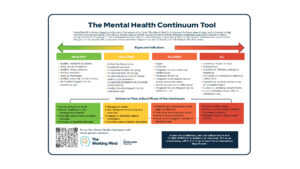
Most managers never get training on what to do next. The Working Mind teaches leaders to recognize where someone sits on the mental health continuum and start a supportive conversation early, before strain becomes absence.
5. Balance treated as a safety issue
Balance is one of the 13 psychosocial factors in the CSA Z1003 standard. Leading employers treat it like any other workplace hazard. They measure it, assign owners, and review it.
Psychological Health and Safety training gives leaders the tools to build balance into policies and processes instead of leaving it to individual willpower.
Check your own initiatives
Ask these questions about each balance program you run:
- Does it change workload or working hours, or does it only add a perk?
- Do senior leaders follow it?
- Do you measure whether it works?
- Do managers know how to support it?
If the answer to most is no, your program treats the symptom. Start with workload, and the rest gets easier.