
Most Canadian employers have a health and safety program. They track slip-and-fall incidents. They inspect equipment. They run fire drills.
But ask them about psychosocial hazards — and many go quiet.
The silence is expensive. And in 2026, it is no longer legally defensible.
What Are Psychosocial Hazards?
Psychosocial hazards are workplace conditions harmful to psychological health. They are not personality conflicts or individual stress responses. They are structural features of how work is organized, managed, and experienced.
According to CCOHS — Mental Health: Psychosocial Risk Factors in the Workplace, common hazards include:
- High job demands with low control
- Role conflict and role ambiguity
- Lack of psychological support from supervisors
- Chronically unmanageable workloads
- Poor recognition for effort and results
- Workplace harassment, bullying, and discrimination
- Organizational change communicated poorly or not at all
- Interpersonal conflict left unaddressed
None of these are invisible. Every one of them shows up in your team’s behaviour, your absenteeism data, and eventually your workers’ compensation claims.
Why Canadian OHS Programs Are Missing the Mark
Traditional occupational health and safety focuses on physical hazards. Noise levels. Chemical exposures. Ergonomics. These matter — but they represent only part of the risk picture.
Psychosocial hazards are harder to measure. There is no decibel meter for a toxic management culture. There is no air quality test for chronic overwork. So many organizations either ignore these hazards or address them reactively — after someone is already in crisis.
The data tells a clear story. According to Statistics Canada’s Canadian Survey on Working Conditions 2024-2025, one in five working Canadians — 21% — report high to extreme levels of work-related stress. Nearly one in four (24%) report experiencing burnout most or all of the time. And only 52% of managers feel able to identify when a team member is struggling.
The gap between what leaders notice and what employees experience is where psychosocial harm grows.
The Legal Obligation Is Already Here
Some employers still treat psychological health and safety as optional — a nice extra they will get to eventually. This position is wrong.
The CSA Z1003 National Standard for Psychological Health and Safety in the Workplace was published in 2013. It defines 13 psychosocial factors every employer should assess and address. Regulators and courts across Canada now reference it in mental injury claims and occupational health audits.
Ignoring psychosocial hazards is not a neutral act. It creates liability.
The 13 Psychosocial Factors You Need to Know
The CSA Z1003 standard and supporting research identify 13 factors defining a psychologically healthy and safe workplace. Assess your organization against each one:
- Psychological support — Do managers respond constructively when employees raise mental health concerns?
- Organizational culture — Does your workplace value openness, honesty, and respect?
- Clear leadership and expectations — Do employees know what is expected and feel confident in leadership decisions?
- Civility and respect — Are all employees treated with dignity regardless of role or seniority?
- Psychological demands — Are workloads reasonable and deadlines achievable?
- Growth and development — Do employees have opportunities to learn and advance?
- Recognition and reward — Are contributions acknowledged in meaningful ways?
- Involvement and influence — Do employees have input into decisions affecting their work?
- Workload management — Are work demands manageable without chronic overtime?
- Engagement — Do employees find their work meaningful?
- Balance — Does the organization support employees in maintaining work-life balance?
- Psychological protection — Are employees protected from harassment, bullying, and discrimination?
- Protection of physical safety — Does a safe physical environment support psychological well-being?
Where do gaps exist in your organization? Start there.
How to Identify Psychosocial Hazards in Your Workplace
Identifying psychosocial hazards requires both data and conversation. Neither alone is enough.
Data sources to review:
- Absenteeism and presenteeism rates
- Turnover data — especially involuntary and early-tenure exits
- Employee assistance program (EAP) utilization trends
- Disability claims with mental health diagnoses
- Exit interview themes
- Engagement survey results over time
Qualitative methods:
- Confidential focus groups with frontline staff
- One-on-one conversations between managers and direct reports
- Anonymous pulse surveys focused on psychological safety
- Walk-throughs of physical work environments with attention to noise, crowding, and isolation
Many organizations skip the qualitative step. Numbers tell you something is wrong. Conversations tell you why.
What Good Controls Look Like
Controlling psychosocial hazards follows the same hierarchy of controls used in physical safety — elimination first, substitution second, administrative controls third, individual supports last.
Eliminate the hazard:
- Redesign jobs with unreasonable demands built into them
- Remove processes creating chronic ambiguity about roles or expectations
- End practices rewarding overwork and penalizing recovery
Reduce the hazard through management practices:
- Train supervisors to recognize and respond to psychological distress
- Build regular check-ins into team routines — not performance management conversations, but genuine ones
- Create clear, accessible reporting pathways for workplace harassment and bullying
Support the individual:
- Ensure EAP access is well communicated and stigma-free
- Provide mental health days as a legitimate, non-judgmental resource
- Train employees in mental health literacy to recognize early warning signs in themselves and others
Individual supports are important — but they are not a substitute for addressing hazards at the source. An EAP does not fix a broken management culture.
Training Is Part of the Control Plan
Identifying hazards without building capacity to address them leaves the work incomplete. Training gives your people the skills to act — not awareness alone.
Opening Minds offers two programs directly relevant to psychosocial hazard management:
Psychological Health and Safety (PHS) training takes a systems-level approach. It equips HR professionals and wellness champions with the frameworks to assess risk factors, build policies, and create the conditions where psychological safety is the norm — not the exception. If your organization is working to meet CSA Z1003 requirements, this is the program to start with.
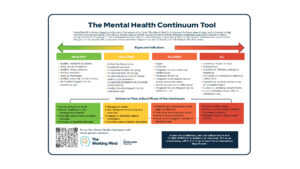
The Working Mind (TWM) is a workplace-focused mental health training program designed to change how employees and managers think, feel, and act about mental health. TWM builds the individual skills supporting a psychologically safe environment — recognizing stress responses, communicating with care, and maintaining well-being under pressure.
Together, these programs address both the organizational system and the individual within it.
Where HR and Wellness Champions Come In
Psychosocial hazard management is not the job of mental health professionals alone. HR teams and wellness champions are positioned to lead this work — because they sit at the intersection of policy, people, and organizational systems.
Your role includes:
- Integrating psychosocial risk assessment into your existing OHS review cycle
- Advocating for job redesign when workloads or role structures create chronic risk
- Building training plans reaching managers first — supervisor behaviour is one of the strongest predictors of team psychological health
- Tracking leading indicators (engagement scores, EAP usage, absence patterns) rather than waiting for lagging ones (claims, turnover)
Ask yourself: does your current OHS program include a psychosocial hazard assessment? If not, what would it take to build one?
The Missing Piece Is No Longer Optional
Physical safety compliance without psychological safety compliance is an incomplete program. The regulatory environment, the claims data, and the workforce expectations of 2026 all point the same direction.
Psychosocial hazards are real. They are measurable. Organizations addressing them systematically build workplaces where people do their best work and stay.
Organizations waiting for a crisis will spend far more — in claims, in turnover, in reputation — than those who build the systems now.
Start with a hazard assessment. Build your control plan. Train your managers. The tools and the training exist. The question is whether your organization is ready to treat psychological health the same way it treats physical health — as a non-negotiable standard.